Posts

Day Trip to Bird Island — Nana Beltran

Image
Today we visited Isla San Jorge, which is also known as Bird Island, it sits between Caborca and Puerto Peñasco. It is considered a very important location for migratory birds and it is considered a very important asset to marine biology. This island is home to one of the most dense populations of Sea Lions. The younger sea lions came very close to the group even as we snorkeled close to our boat. They are very friendly and very very curious about humans. Now I know why they called them the puppies of the sea.   Along the way to another side of the island we had the opportunity to come across a whale shark. A very rare opportunity, even in Puerto Peñasco. It was such a beautiful and majestic creature. I am so happy I got the chance to experience seeing one in the ocean. Definitely a once in a lifetime experience!
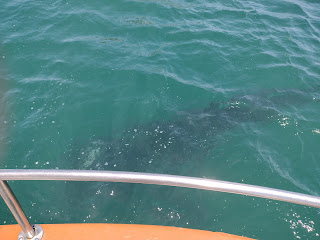
Look What We Came Across On Our Boat Trip

Image
 Nothing is more fun than taking a boat out to go snorkeling, except if you come across a whale shark.  I was  hoping to see more, but this was even better.  The sea lions on the island were as curious as was explained and the island was covered with many birds, most of which were boobies.  I think they said there were blue footed boobies and brown boobies out on the island.  Boy did the island smell!  Between sea lions and bird poop that covered and made it look white, it definitely is a stinky island.  I think the divers had a better time seeing things under the water, even though the visible was low. --Laura

Osprey Nest Observation

Image
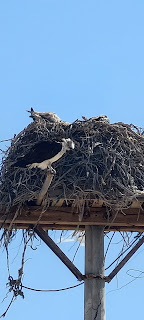
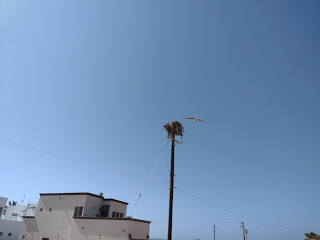
 Today we were nest monitoring osprey. Osprey are beautiful black and white seahawks that only end up having one or two chick that survive. We checked the GPS coordinates, if the nest was active, collect any feather or eggs, and if the were any chicks or juveniles. --Laura

Nest Site

Image
  This morning we went to observe 5 different nesting sites done by Osprey. The observations were based on eggs, chicks, juvenile, adult osprey along with other characteristics surrounding the nest. Thanks to David Cedos Biologist I learned: Osprey are generally monogamous and often mate for life. Males select a nesting site as a pair find items for the nest, but the female arranges the nest. Osprey male will kill one out of three chicks because of the lack of food (survival skills). The chicks will also try to kill each other for the same reason food. At the end they will be one chick who will survive unless theirs enough food for all chicks.  They have long wings and small tails.   They take turns looking after their chicks, when one parent flies away for a long period of time the one who stays behind calls out for their return. During this activity in one of the nest site David collected feathers and egg shells.  Taking notes what nest it was found and time to be ...

Ecology

Image
Yesterday we had a brief lecture on ecology. Ecology is the study of how and why organisms interact with one another and their environment.  We learned that o rganisms must adapt to both biotic and abiotic factors of their communities.      - Abiotic factors: lack of sunlight, too much sunlight, evaporation, currents, UV radiation, etc.      - Biotic factors: fouling, parasites, predators, competition for food, etc. Each species in a community has its own ecological niche, or special role. And p opulation growth depends on limiting resources, like oxygen or CO2, food and nutrients, space (habitat), and physical factors. The largest population size that can be supported by the available resources is called carrying capacity .  We also learned about the major marine environments:      - Benthic: sessile organisms that live on the bottom      - Pelagic: organisms that live in the water column A gorgonian attached to a...

Serenity- FYI

Image
  For Your   Information Or Fireworms Yare super Inot the move This is a PSA that I feel strongly about! If you go tide-pooling at any beach, watch out for these guys (pictured in red worm). Sometimes called a bristleworm, these friends will shoot out little bristles like a porcupine mixed with a desert tarantula’s leg hair mixed with a worm. They look soft, but those white marks on the edge are razor sharp and will lodge themself in the flesh of whoever winds up being their unlucky victim. Then, the excess of the “hair” breaks off, leaving the residue in the skin. The skin generally becomes extremely irritated, in some cases developing a rash. Because the hairs are small and clear, it’s difficult to pull them out with tweezers, and unsanitary to pull them out with tape. The best thing to do is to wear gloves and water shoes and stay away. The second best thing to clean the area well, rinse in hot water for 15 minutes, wash in vinegar, and to wait.  Fortunately, there’s s...

Serenity- Echinodermata Ecology

Image
 One of our assignments for this course included studying a phylum of invertebrates and creating a presentation on them. My group studied Echinodermata and I covered the ecology of such- how they interact within and with their environment. I figured I’d share some of the things I learned on this blogpost! As a general rule, echinodermata are sessile, deposit-feeders, and have a vascular system that allows them to suction onto more solid objects. (there are several other identifying factors, but those are a few that directly affect the environments they choose to live in). Ecology covers interspecies community interactions, and I loved learning about the doubly positive symbiotic  relationships sea anemones (an echinoderm) share with hermit crabs. Being sessile, it is hard for anemones to quickly escape predators, so sometimes they will attach themselves to a hermit crab shell. They feed off the deposits of organic matter in the water low to the ground as the crab moves along, ...